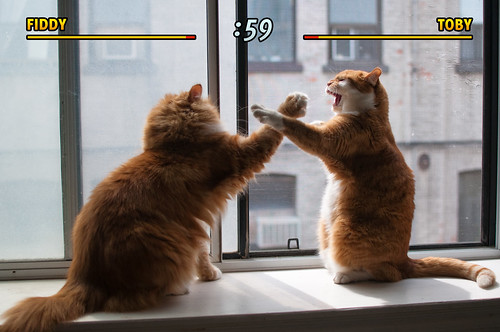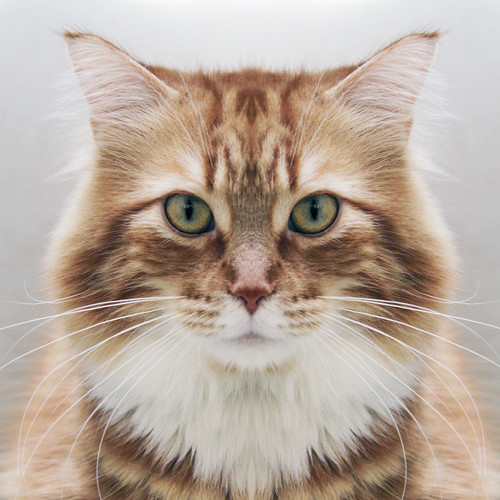
06.05.2007 – Recently, while I was away from the internet, a photo of mine (above) was lolcatted. Lolcat is the term for combinations of cat pictures and odd captions that are currently popular on the internet. (Wikipedia entry)
¶ I’ve secretly hoped that one of my pictures would be turned into a lolcat, and it’s been a mostly fun experience.
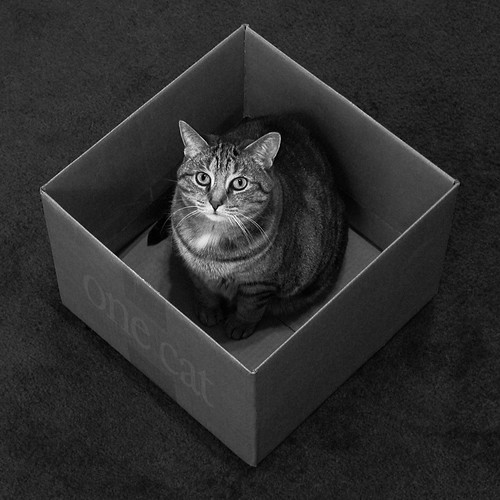
¶ I made the picture above of Xena, added the text one cat to the box in Photoshop, and posted it on Flickr a year ago, where it has been popular. It’s been my buddy icon on Flickr, and I have considered using it as a personal trademark. It was also my first cat picture to make the cover of a magazine! You probably did not see it on the newstands:
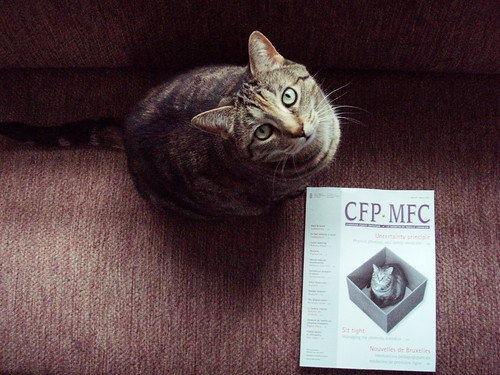
¶ The Canadian Journal of Family Physicians used it on the cover of their March issue for an article called Uncertainty Principle, making official the association with Schrödinger’s cat.
CUT TO SOME TIME IN MAY, SOMEWHERE ON TEH INTARWEB...
¶ Justin Wick and Dan Lurie were chatting online about quantum cryptography, you know, like everyone does, and they hit upon an instance of the notion of Schrödinger’s lolcat.
¶ When Dan went looking for a cat in a box he could look no further when he found my picture. Xena’s expression is perfectly indeterminate while the textures and shapes suggest the mathematical precision of an Escher print. Combined with a lolcatspeak caption suggesting Schrödinger’s cat-threatening thought experiment, it would prove irresistable to lolcat fans.
DAN POSTED THE CAPTIONED PHOTO MAY 30. (DAN’S STORY)
¶ Friday morning, June 1st, the lolcat came to the attention ofAccordion Guy Joey Devilla, who was amused and reposted it to his very popular blog. By then the lolcat was already travelling the internet unattributed. Coincidentally, Joey and I were working together at Mackerel back when the web was brand new and not so shiny.
¶ Another friend of Mackerel, Cory Doctorow, saw Schrödinger’s lolcat on Joey’s blog and posted it as an anonymous lolcat atBoingboing where it’s been seen by thousands of people, and picked up by dozens of sites. Meanwhile, a Digg user noticed Joey’s post and linked to it.
¶ My little Xena was really getting around! This is about where I found out about it (thanks, Rob!), although I was away from my email — or even a modern web browser for web mail — for at least another day.
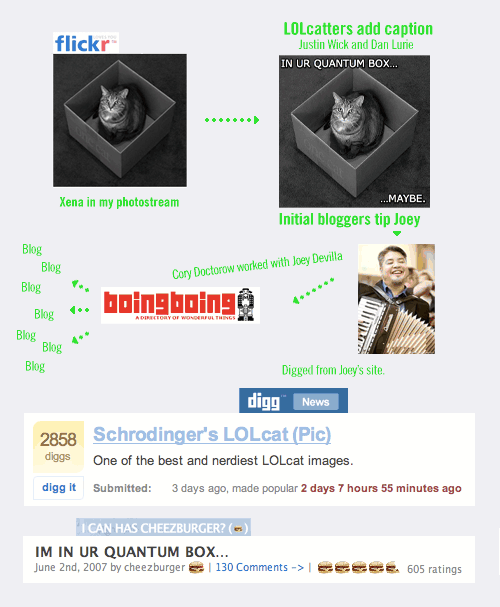
¶ There was some frustration along with the excitement because at first so many were seeing the image without proper attribution, but that situation has been remedied. The big sites now have proper attribution (thanks Rob, Cory, Joey!) so no one should assume the work is anonymous. While I did have to ask one person to take down a commerical product with this lolcat, it was not a serious problem.
¶ Inevitably the lolcat was found by lolcat aggregator I Can Has Cheezburger where it was properly attributed. Fans of lolcats rate this one highly.
¶ Some geeks will never be satisfied, of course. At Digg a number of posters eventually soured the comment thread by arguing scientific inaccuracies and suggesting that anyone that gets the joke and laughs does not actually understand quantum physics.
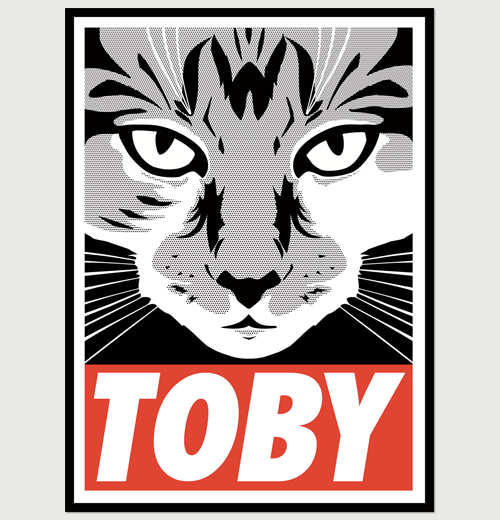
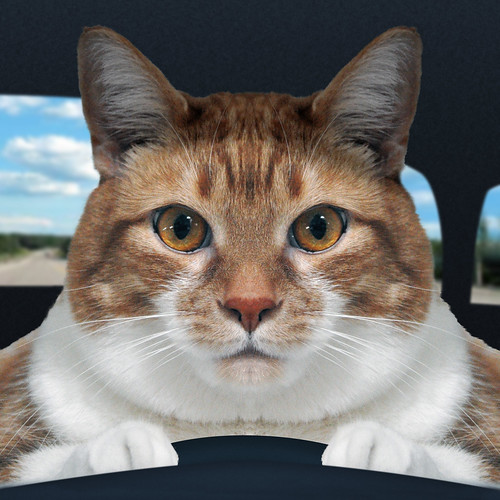
XENA AND TOBY ARE BORN LOLCATS
¶ I think I have some other pictures that will make good lolcats, but nothing that will capture the geek imagination like Xena in a box. That won’t stop me from tossing a lolcat out there:

SO YOU WANNA MAKE A LOLCAT WITH ONE OF MY SHOTS?
¶ The bulk of my photos are available for some Creative Commons uses. To use one of my CC photos for a lolcat, please email me. I will most likely approve the change in CC license necessary to submit to some sites.
¶ Dan Lurie has my permission for the non-commercial lolcat. I do wish to assert that my picture of a cat in a box remains ©all rights reserved. This one has been special to me.
UPDATE 02.23.08 – My lolcat was a hit at I Can Has Cheezburger which was satisfying. I have put a few more out there and probably have more lolcats in me. The phenomenon has not lost any momentum. New people are still discovering lolcats.